 Europe
  United Kingdom
  Türkiye
  USA & Canada
  APAC
APAC  الشرق الأوسط
 Case Studies
  Materials Library
  Articles
  E-Books & Guides
  Webinars
  Free Courses
  Community Discussions
  Free Tools
2027
Manufacturing
Outlook
In 2027, the ability to tap into key manufacturing resources will be an important differentiator. Whether you’re a buyer looking for DFM feedback to build better parts, or a supplier who needs work to fill open capacity, access is your new competitive edge. Read the 2027 Manufacturing Outlook European Edition report to explore four major trends shaping what’s next for manufacturing buyers and suppliers.

Discover Key Trends & Insights
What’s shaping European manufacturing in 2027? Four shifts are set to define the landscape. Explore the key trends covered in the report.
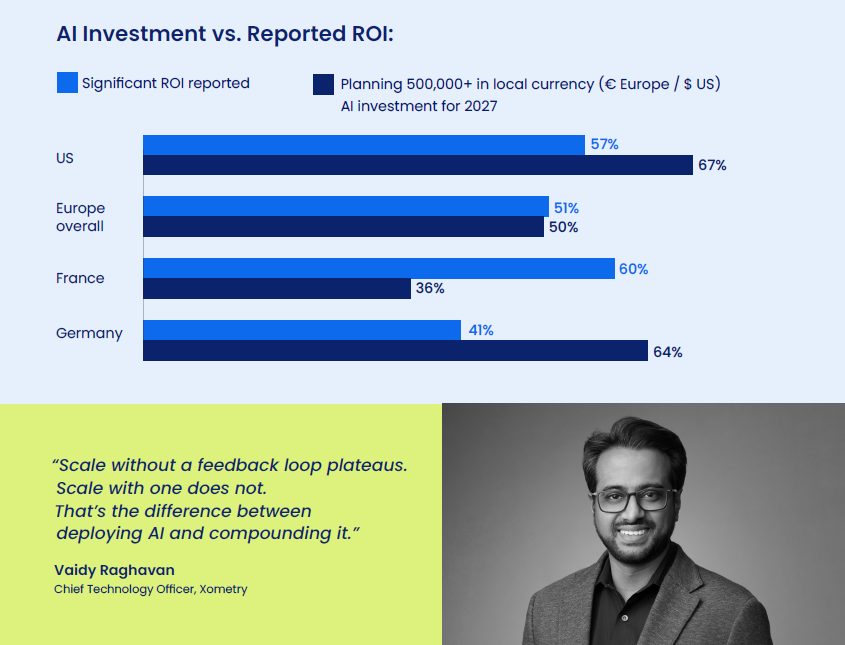
Manufacturing’s AI Payoff Is Upstream
AI is central to European manufacturing. Strategic application delivers value, not bigger budgets alone.- Spending isn’t payoff: 64% of German manufacturers plan to invest €500,000+ in AI in 2027, yet 41% report significant ROI so far, compared with 60% in France and 57% in the US.
- Local priorities: Germany leads on AI for DFM or manufacturability review (59%). France leans on AI for pricing and quoting (61%).
- The bigger opportunity: AI’s impact shows up before a part is produced, in how it’s designed, priced and sourced.

Europe’s Manufacturing Capacity Is Hiding in Small Shops
Europe’s challenge is less about lacking capacity and more about accessing what already exists.- Capacity sits in smaller shops: 37% of European manufacturers with under €50M in revenue operate below 70% capacity, compared with 11% of those with over €100M.
- Room to put capacity to work: 81% of French manufacturers run at 70% capacity or higher, compared with 71% in Germany, even though backlogs are similarly strong.
- Access matters: certification and compliance are the second most cited challenge in Europe. They shape which capacity buyers can actually use.
Supplier Optionality Is the New Sourcing Advantage
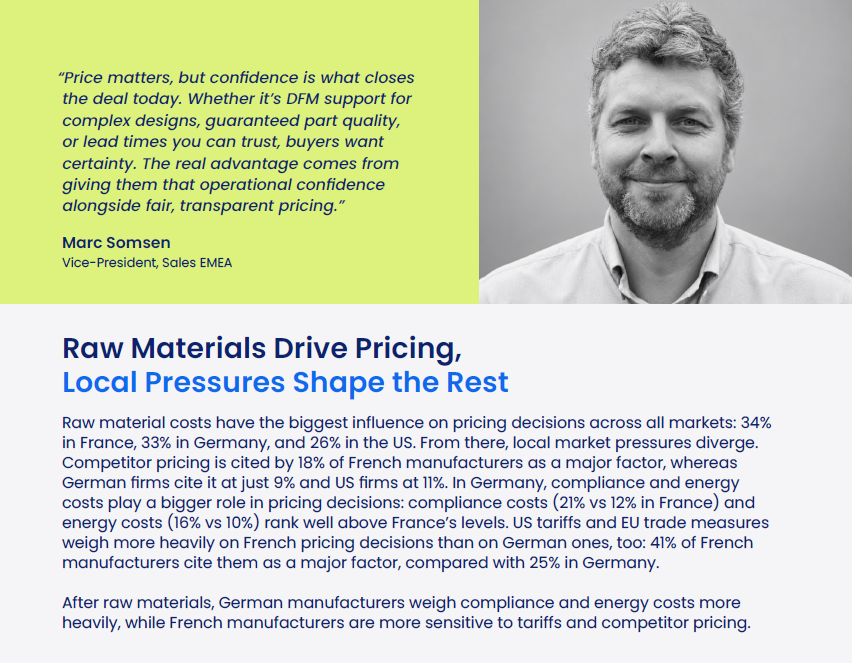
Buyers cannot control rising input costs, but they can control how many qualified alternatives they secure.- Limited pushback: 82% of French and 76% of German manufacturers raised prices this year.
- Certainty carries a premium: 71% of French and 64% of German manufacturers charged a premium for verified quality, and 57% and 53% did so for DFM support.
- More than price: Buyers are looking for certainty around quality, timelines, and alternatives when conditions change.
Manufacturing Needs Skills, Not Just Headcount
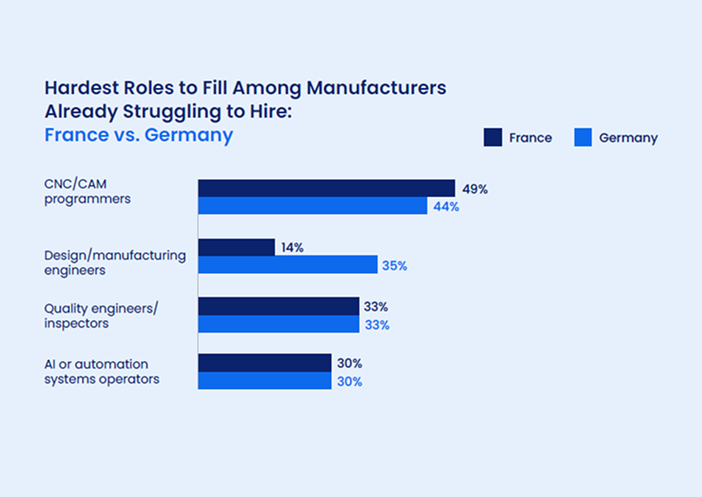
Europe’s labour challenge is a shortage of specialised expertise rather than simply a lack of people.- Hard-to-fill roles: CNC/CAM programmers remain among the hardest positions to recruit in France and Germany.
- Germany’s engineering gap: 35% of German manufacturers identify design and manufacturing engineers as their hardest role to fill.
- Pay helps—but unevenly: 91% of German manufacturers that raised wages say it helped attract more qualified candidates, compared with 74% in France.
A View from Oscar Lovera
Xometry Chief Operations Officer, International, Oscar Lovera
discusses how procurement teams should rethink sourcing
as supply chains become more complex.